On November 10, 2026, the United States Marine Corps turns 251. Across the country, Marines will cut birthday cakes, gather at Birthday Balls and raise the scarlet and gold. The flag they raise has a story of its own, and it took more than 160 years to reach the design we know today. Every November, families and veterans start looking for the right flag to mark the day.
History of the United States Marine Corps Flag
The united states marine corps flag didn’t arrive with the Corps. It grew slowly, shaped by the Marines who carried it into battle. Here’s how it went from early banners to an official design.
From the Continental Marines to the Eagle, Globe and Anchor
The Corps began on November 10, 1775, when the Second Continental Congress voted to raise two battalions of Continental Marines. For their first century, Marines served under the flags of the young nation rather than one of their own. That began to change on November 19, 1868, when Commandant Jacob Zeilin adopted the eagle, globe and anchor as the Marine Corps emblem. The motto Semper Fidelis, meaning “Always Faithful”, followed in 1883.
January 18, 1939: Scarlet and Gold Become Official
Early Marine flags often used a blue field. On January 18, 1939, Marine Corps Order No. 4 made scarlet and gold the official Marine Corps colors and set the standard flag design. That’s the flag still flown today: the emblem in the center of a scarlet field, with Semper Fidelis on a scroll in the eagle’s beak and “United States Marine Corps” below it.
What the Marine Corps Colors and Emblem Mean
Every part of the flag was chosen on purpose. The scarlet and gold have been tied to the Corps for generations, and today Marines see them on everything from dress uniforms to the Birthday Ball. For many Marines and their families, those two colors mean home.
Eagle, Globe and Anchor and Semper Fidelis
The eagle stands for the nation Marines defend. The globe shows their service around the world, and the anchor points to their roots at sea and their amphibious mission. Semper Fidelis ties it all together, a promise of loyalty to the country and to each other that lasts long after service ends.
Marine Corps Flag vs Battle Color vs Guidon
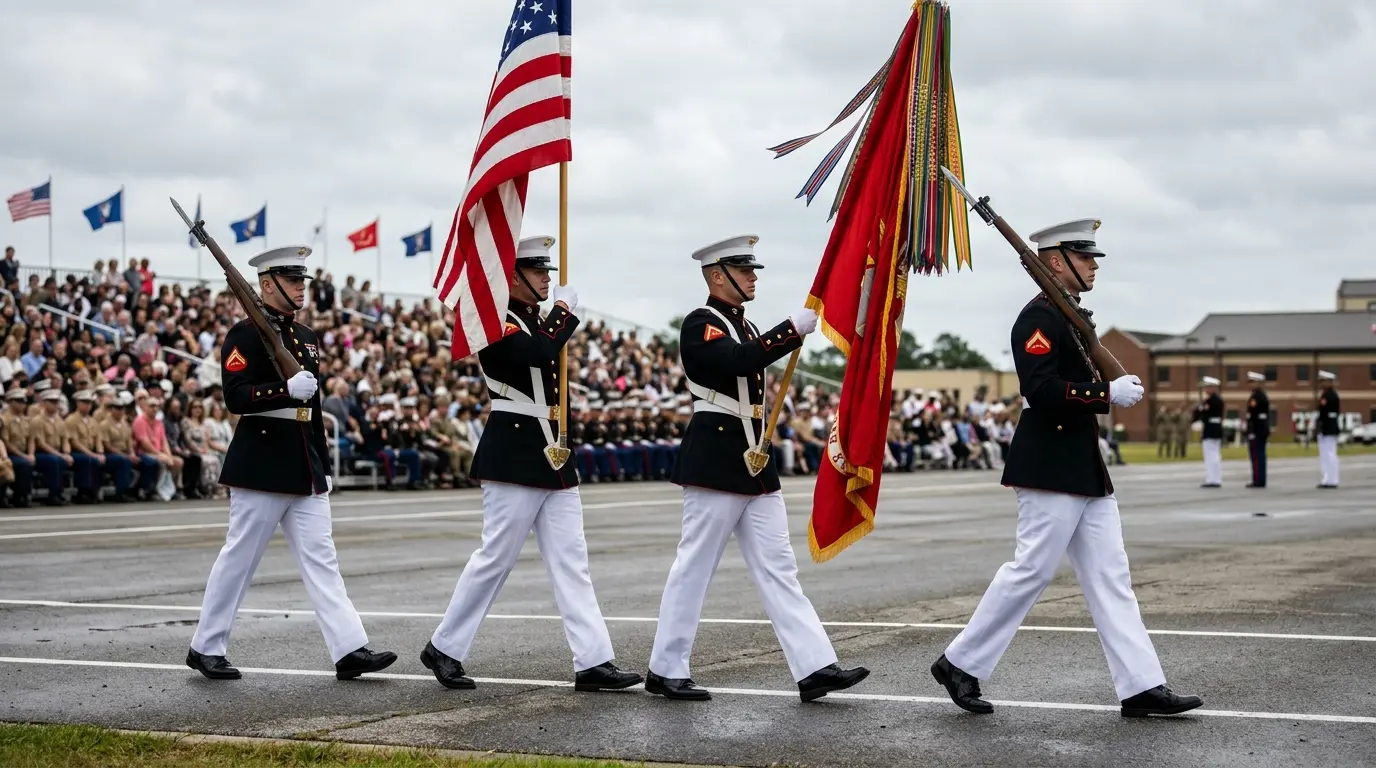
These names often get mixed up, but they aren’t the same flag. The Marine Corps flag is the standard scarlet and gold design anyone can fly at home or at work. The Battle Color is the Corps’ official flag, carried by the Marine Corps Color Guard and covered in battle streamers that honor its campaigns. A guidon is a smaller flag that marks an individual unit, like a company. If you’re buying for a home or office, the standard Marine Corps flag is the one you want.
How to Display the USMC Flag with the American Flag
The USMC flag looks its best beside the Stars and Stripes, but the American flag always comes first. Fly the US flag in the position of honor, to its own right (the viewer’s left), at the same height or higher. Raise it first and lower it last.
Order of Precedence with Other Service Flags
If you fly more than one service flag, they follow a set order: Army, Marine Corps, Navy, Air Force, Space Force and Coast Guard. Getting this order right matters, especially at schools, veterans posts and public buildings where people notice. For a home flagpole or porch, our 3' x 5' US Marine Corps Nylon Flag is a popular size, and the Marine Corps desk flag 12 pack works well for Birthday Ball tables.

Fly It Proudly This November 10
The Marine Corps flag carries 251 years of history in one simple design. Whether it flies on a porch, sits on a desk or hangs at a reunion, it honors everyone who has earned the title Marine. This November 10, fly it proudly, and fly it right. As an American made flag company, we know how much a properly displayed flag means to the people who served under it. Shop now
FAQ's
Officially, it’s scarlet. Scarlet and gold have been the official Marine Corps colors since 1939.
November 10. In 2026, the Corps turns 251.
It’s the Corps’ official flag, carried by the Marine Corps Color Guard, with streamers honoring Marine campaigns.
US Marine Corps Flag: History, Colors and How to Fly It